Plantagenet Descendants Society
of the United Kingdom

Plantagenet Descendants Society News.
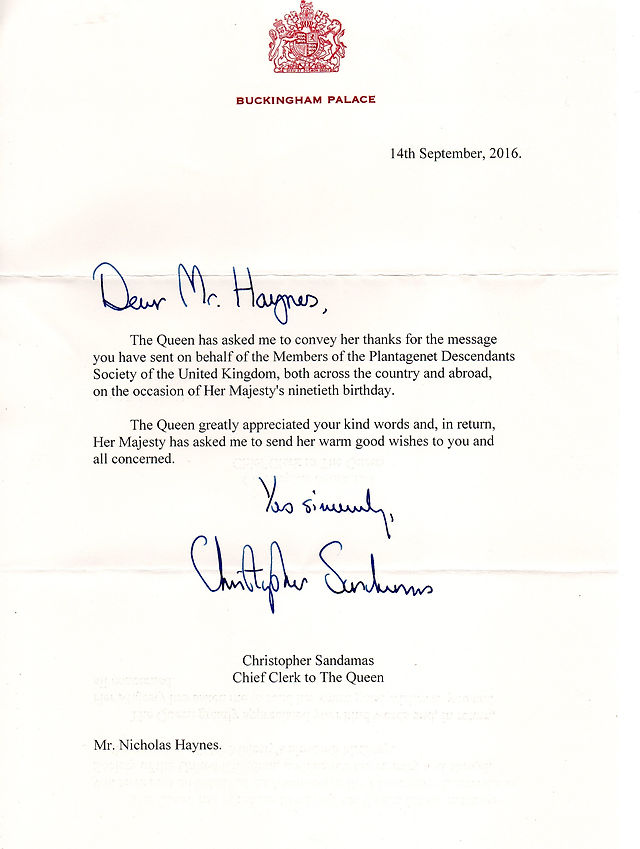
Message from Buckingham Palace
The following letter was recieved by the Plantagenet Descendants Society UK from Buckingham Palace on behalf of Her Majasty Queen Elizabeth II thanking the members of the Society from both the UK and abroad for her 90th Birthday wishes.
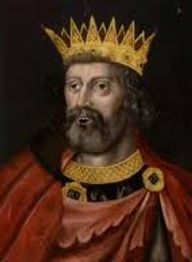
1st October 1207 - Henry III born
Henry was born in Winchester Castle on 1 October 1207] He was the eldest son of King John and Isabella of Angoulême. Little is known of Henry's early life. He was initially looked after by a wet nurse called Ellen in the south of England, away from John's itinerant court, and probably had close ties to his mother. Henry had four legitimate younger brothers and sisters – Richard, Joan, Isabella and Eleanor – and various older illegitimate siblings. In 1212 his education was entrusted to Peter des Roches, the Bishop of Winchester; under his direction, Henry was given military training by Philip D'Aubigny and taught to ride, probably by Ralph of St Samson.
Little is known about Henry's appearance; he was probably around 168 centimetres (66 in) tall, and accounts recorded after his death suggested that he had a strong build, with a drooping eyelid. Henry grew up to occasionally show flashes of a fierce temper, but mostly, as historian David Carpenter describes, he had an "amiable, easy-going, and sympathetic" personality. He was unaffected and honest, and showed his emotions readily, easily being moved to tears by religious sermons.[8]
At the start of the 13th century, the Kingdom of England formed part of an empire spreading across Western Europe. Henry was named after his grandfather, Henry II, who had built up this vast network of lands stretching from Scotland and Wales, through England, across the English Channel to the territories of Normandy, Brittany, Maine and Anjou in north-west France, onto Poitou and Gascony in the south-west. For many years the French Crown was relatively weak, enabling first Henry II, and then his sons Richard and John, to dominate France.
In 1204, John lost Normandy, Brittany, Maine and Anjou to Philip II of France, leaving English power on the continent limited to Gascony and Poitou. John raised taxes to pay for military campaigns to regain his lands, but unrest grew among many of the English barons; John sought new allies by declaring England a Papal fiefdom, owing allegiance to the Pope. In 1215, John and the rebel barons negotiated a potential peace treaty, the Magna Carta. The treaty would have limited potential abuses of royal power, demobilised the rebel armies and set up a power-sharing arrangement, but in practice neither side complied with its conditions. John and the loyalist barons firmly repudiated the Magna Carta and the First Barons' War erupted, with the rebel barons aided by Philip's son, the future Louis VIII, who claimed the English throne for himself. The war soon settled into a stalemate, with neither side able to claim victory. The King became ill and died on the night of 18 October, leaving the nine-year-old Henry as his heir.
Keep up to date with Historical Anniversaries.
Plantagenet Kings and their families made history in Engalnd and across Europe. Major historical events and news will be reported here. Keep up to date with the events Planatagenet Kings were involved, such as the battle of Agincourt.
The Plantagenet Descendants Society have an active Facebook page. Feel free to visit the Facebook Page and follow the Society.
Plantagenet Descendants Society UK
Don't forget to 'Like' the Facebook page and help the Plantagenets Descendants family to grow.
Plantagenet of the Month
The Plantagenet Descendants Society UK will produce monthly articles on a Plantagenet containing histroical information concerning the Planatgenet chosen.
For a copy of the latest information please click the DOWNLOAD button.
Plantagenets We Are Here For You!
Join the Plantagenets Descendants Society UK today.
Contact us now
plantagenetuk@gmail.com


